Choosing woodworking furniture plans can feel overwhelming, especially when you want authentic Craftsman style rather than generic modern knockoffs. You need plans that guide you through real joinery, proportions, and finishes without requiring a workshop full of expensive tools. The question is whether a classic reprint like Making Authentic Craftsman Furniture can deliver that guidance without costing a fortune.
Quick verdict
At USD 6.00, this very good-condition trade paperback reprint is a remarkably affordable entry into traditional furniture making. It collects instructions and plans for 62 projects from Gustav Stickley, the name most associated with the American Craftsman movement. If you are looking for a broad reference of period-accurate designs and don't mind working from older-style instructions, this book offers substantial material for the price.
The book is a reprint of Stickley's original work, which means you get the historical plans and text as they were first presented. The trade paperback format keeps it portable and easy to keep open on a workbench. The condition is described as very good, so you can expect a usable copy without heavy wear.
Who it suits
This is best for woodworkers who want a survey of Craftsman furniture designs before committing to a single project. With 62 projects to browse, you can compare different tables, chairs, and case pieces to find the style that fits your space. It also suits anyone who appreciates authentic period details and wants plans rooted in the Arts and Crafts tradition.
If you are a beginner looking for step-by-step modern illustrations and cut lists, this may not be your ideal first plan book. The instructions are original-period text, so you should be comfortable interpreting traditional woodworking language and adapting measurements to your own tools.
What stands out from the listed details
The scope is the biggest standout. Having 62 projects in one volume at this price gives you a wide range of options without buying multiple booklets. The Craftsman style is known for honest joinery and simple lines, and Stickley's designs are the reference point for that look. The author attribution matters too: this is not a modern reinterpretation but a reprint of Gustav Stickley's own plans.
Another positive is the format. A trade paperback is lightweight and sits flat on a bench more easily than a spiral-bound pamphlet or loose-leaf plans. The reprint feature also means the content has been preserved in a standard book format, which makes it easy to flip between projects.
The very good condition is worth noting for a used book. You get the full content without paying collector prices for a first edition.
Meaningful trade-offs
Because this is a reprint of historical plans, you should expect the original language and construction methods. There may be references to tools that are less common now, and you will need to adapt some techniques. The book is not a step-by-step course for beginners with detailed photos of every joint; it is a plans collection with instructional text.
The 62 projects are likely varied, but you cannot preview the exact selection or difficulty level from the title alone. Some may be more advanced or require specialized lumber. Also, the condition is very good but not new, so there may be minor wear, pencil marks, or a crease here and there. That is typical for a used book at this price.
Another trade-off is the format itself. Trade paperbacks are durable, but they are not waterproof or shop-wipeable. If you plan to take the book near a saw or finish, you may want to photocopy pages or use a protective cover.
Bottom line
Making Authentic Craftsman Furniture gives you a substantial library of Stickley-inspired plans for a very modest outlay. For woodworkers who value historical accuracy and a broad range of project ideas, it is a practical addition to the shelf. If you prefer modern, photo-rich instruction, you may find the older approach limiting. At USD 6.00, the price makes it a low-risk way to explore authentic Craftsman furniture plans and decide which pieces you actually want to build.
Making Authentic Craftsman Furniture: Instructions and Plans for 62 - VERY GOOD
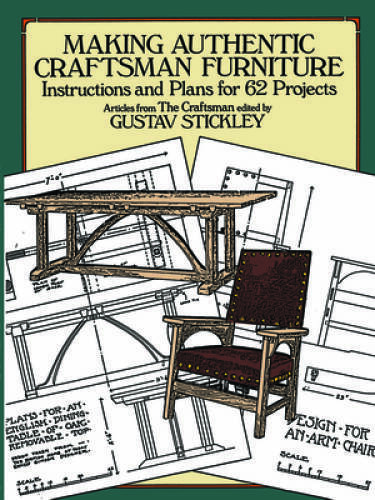
This very good-condition trade paperback reprint presents 62 projects from Gustav Stickley, the key figure in American Craftsman furniture. The strongest reason to pick it up is the combination of author credibility and project volume at a very low price. The main limitation is the historical instruction style, which asks you to work with period language and traditional methods rather than spoon-fed modern steps. If that sounds like a fair trade, it is a smart starting point for your next furniture build.